0.2.1 Attitude Determination and Performance
Kalman Filter Warm Starts
TRIAD, QUEST, and Davenport’s q-method now determine attitude from direction
observations in a single frame. Estimators can use these solutions to
initialize from their first sensor readings through
WarmStart. The warm start also
derives angular rate and its initial covariance from the gyros. Select a solver
with WarmStart(method="triad"), "quest", or "q_method";
"auto" uses a quaternion star tracker when available and QUEST otherwise.
The MEKF is generally faster than the UKF because it propagates one estimate and linearizes the dynamics and measurement model, while the UKF evaluates a set of sigma points. That linearization is local, so a large initial attitude error can make the MEKF fail to converge. Initializing the attitude from the first sensor readings can move the estimate into a region where its local corrections work well, as the example below shows.
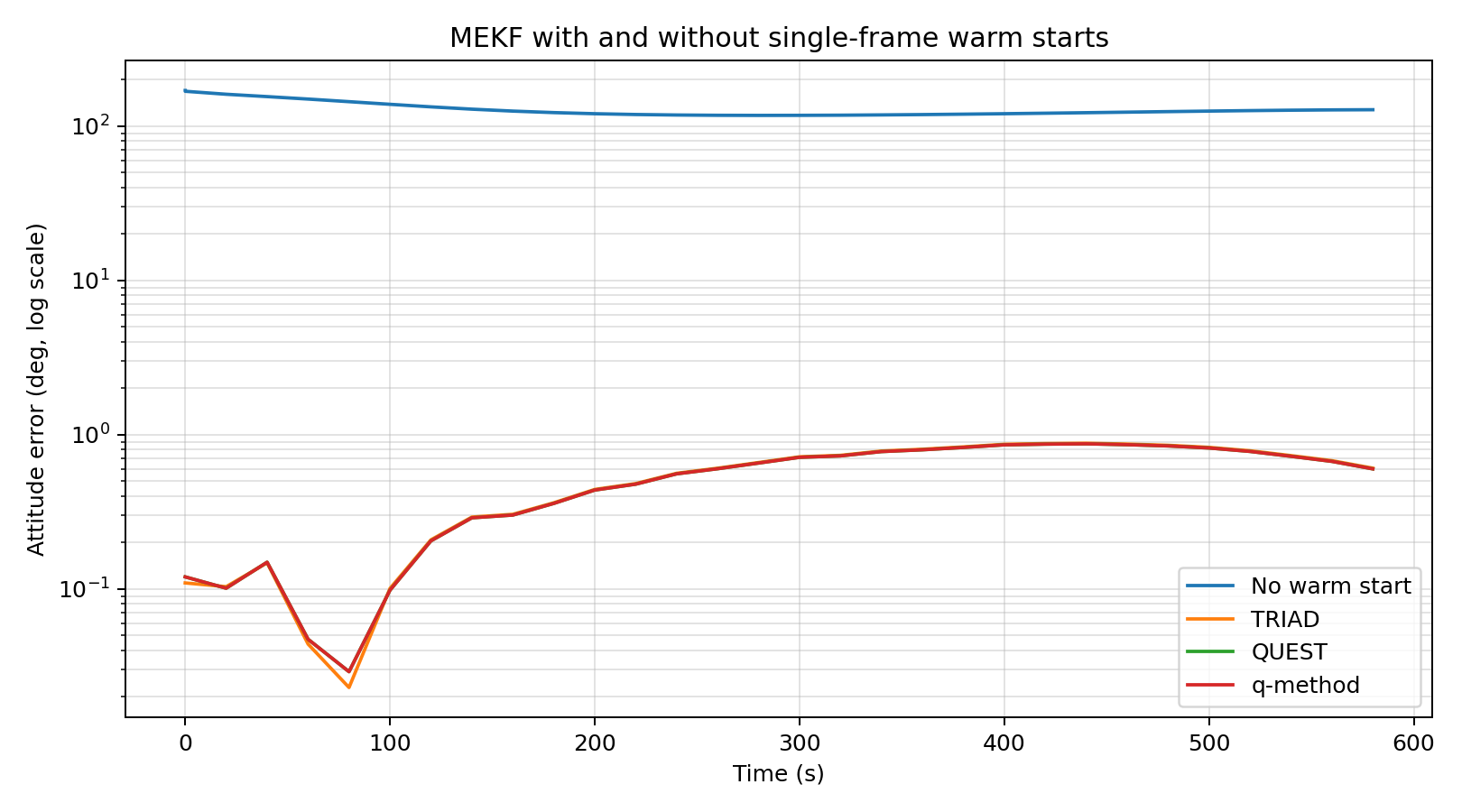
The logarithmic scale shows the separation between the MEKF started from a large attitude error and the three sensor-based warm starts.
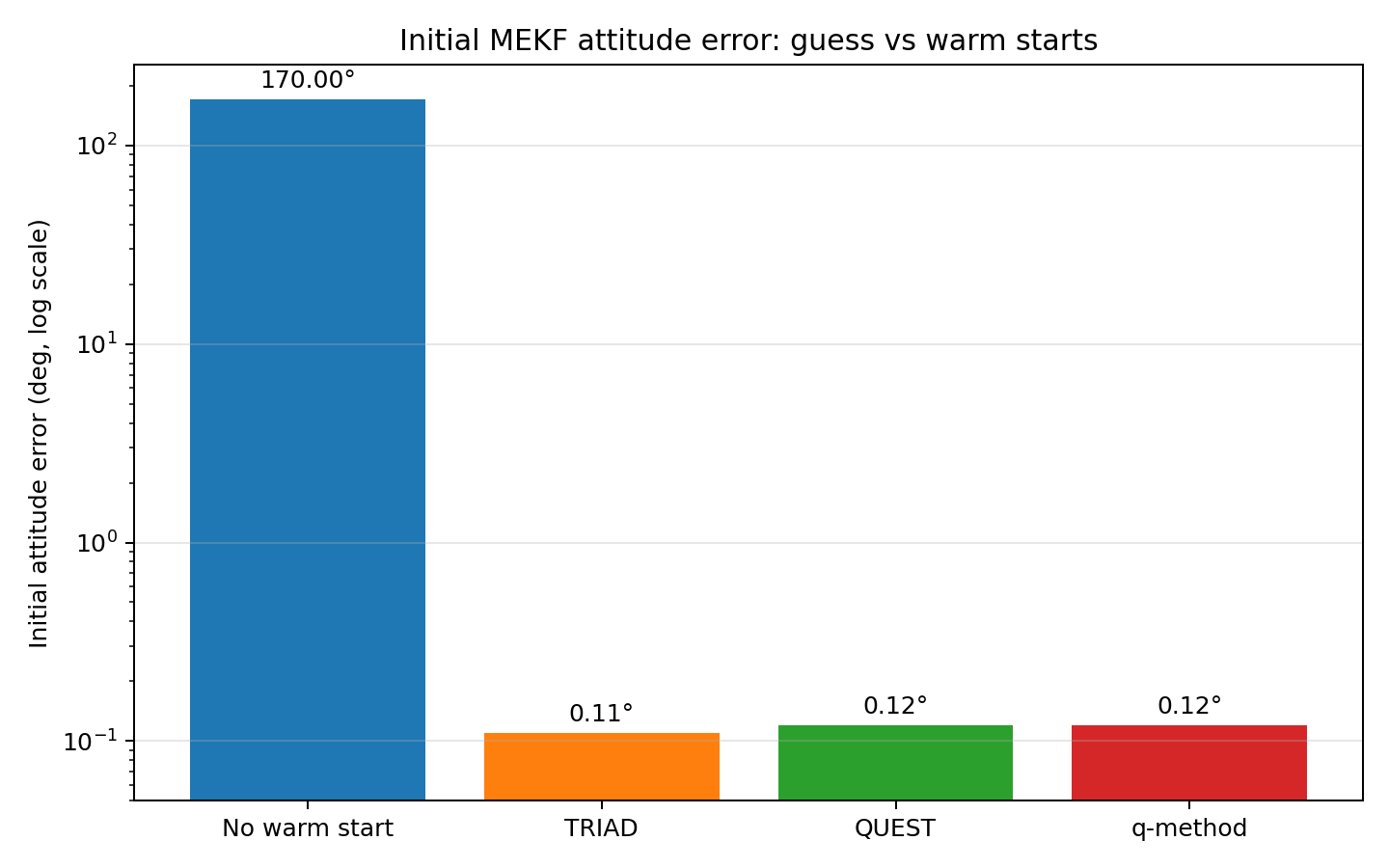
The warm starts estimate the initial attitude to within about 0.12 degrees in this seeded example, compared with the 170 degree supplied guess. The MEKF warm-start comparison script produces both figures.
Filter speed and convergence
The four filters are also compared on the same seeded orbit and sensor scenario. The first plot shows attitude error over time; the second compares whole-simulation wall time per step with attitude error after 100 seconds. Timing includes the common orbit and plant work and is measured after a warm-up run to avoid JIT compilation overhead. Actual timing depends on the machine.
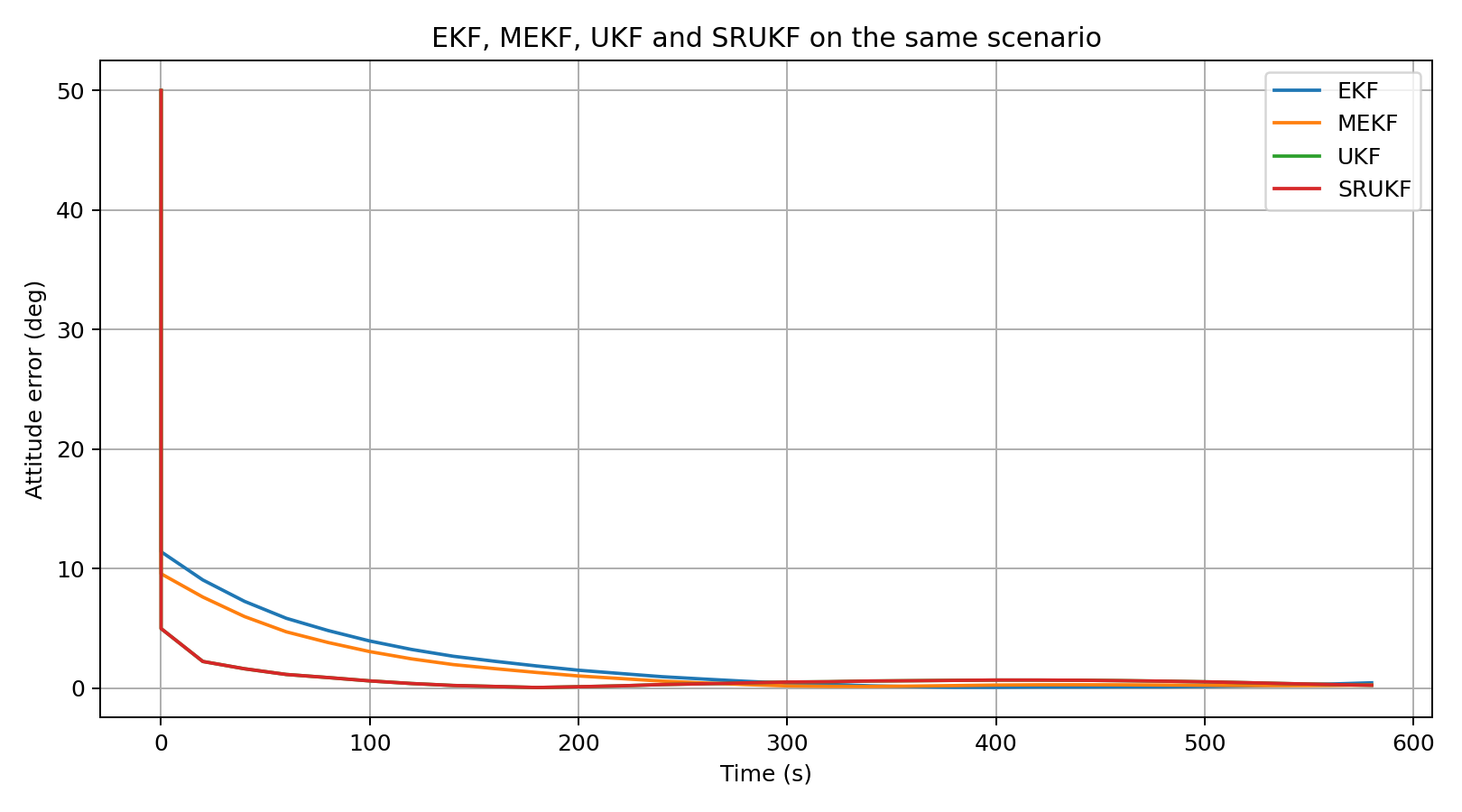
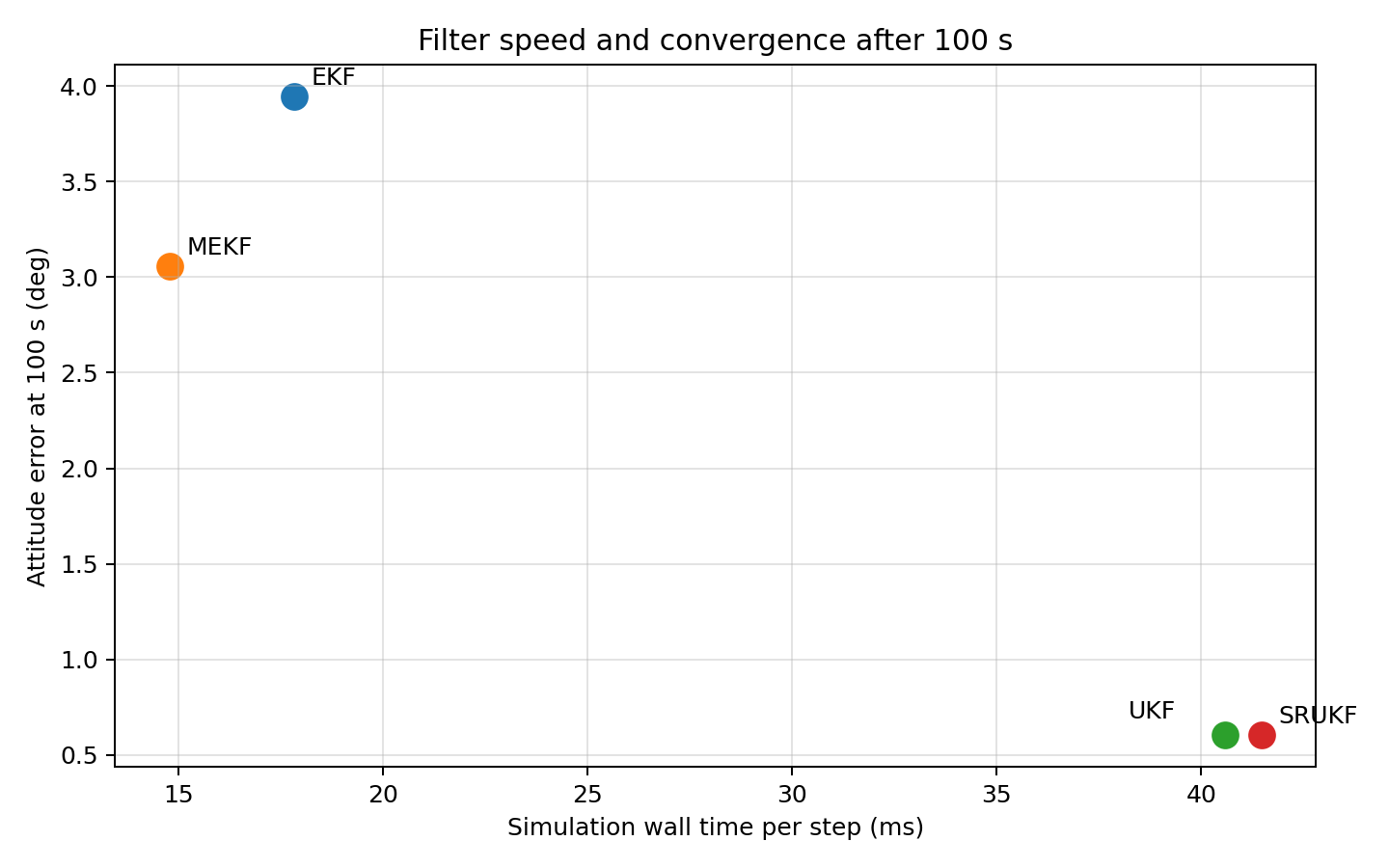
The filter comparison script generates both plots.
100x+ faster geomagnetic fields and tests
The in-tree igrf_numba implementation is now the default geomagnetic field
model for orbit and sensor calculations. The legacy ppigrf backend is an
optional extra; install it with pip install generalized-adcs[ppigrf] if
you import ppigrf directly or select magnetic_model="igrf_ppigrf".
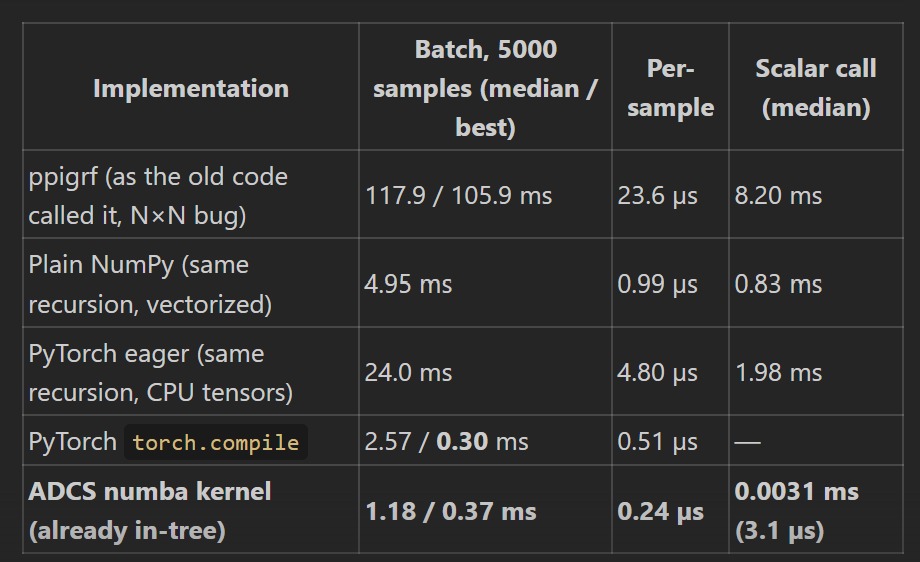
In the simulation’s inner loop, igrf_numba is more than 100 times faster
than the legacy ppigrf implementation.
The benchmark below compares batch and scalar-call performance across the
legacy ppigrf code, NumPy and PyTorch implementations, and the in-tree
Numba kernel. The Numba kernel’s median scalar call is 3.1 microseconds.
Math operations, estimator calculations, and orbit tests have been optimized. The orbit test directory is now roughly 100 times faster, and the test suite has been reorganized by subsystem and behavior.
Public sensor observation protocol
Sensors can declare their public observation type through
observation_kind and provide the corresponding inertial reference through
reference_direction(orbital_state). The protocol is used by single-frame
attitude determination and estimator warm starts, and lets custom sensors
participate without hard-coded sensor-class checks.
Simulation and estimator behavior
The simulate() history is now aligned with its timestamps:
state_hist[k] is the real state at time_s[k]. This is one integration
step earlier than before, so post-processing code that compares histories with
timestamps will see its values shift.
True disturbances now advance once per plant step, so time-varying disturbance models evolve during simulation as intended.
The UKF now drops a sensor when some sigma points cannot see it instead of
aborting the update. Sigma-point spread is kept inside the configured
attitude chart. RK4 midpoint dynamics are averaged consistently in both
update() and simulate(). GPS noise is rotated into ECI using the
correct sensor’s noise model.
Small improvements, changes, and bug fixes
#207: make UKF measurement updates robust to partially unavailable sensors.
#208: keep sigma-point spread inside the attitude chart.
#209: rotate GPS noise into ECI and use the corresponding sensor’s noise.
#211: average the RK4 midpoint in
update()andsimulate().#212: add guard rails and a timestep-versus-orbit check. The removal of
ADCS.estimators.old_attitude_estimatorsis a breaking change for code importing that module.#218: expose the
observation_kind/reference_directionsensor protocol.#220: align
simulate()state history withtime_s.